Interconnection Queue
Power in both senses of the word. One fan shared by everyone in the room, and a line you join from your phone.
- Year
- 2026
- Role
- Concept, 3D model, phone + wall UX, server
- Tools
- Figma, Maya
- Type
- Installation · Phones + wall + fan
Interconnection Queue is about power in both senses of the word: the electricity that runs through the wall, and the control we get to have over it.
A fan is one of the most ordinary pleasures electricity buys, a breeze on demand, and it looks almost exactly like the wind turbines that are supposed to make that electricity in the first place.
Those turbines, along with the solar farms and batteries meant to sit beside them, are mostly stuck waiting. At the end of 2023 close to 2,600 gigawatts of new power sat in line to connect to the US grid, about twice what already runs, and most of it will wait for years or quietly give up.
Numbers from Berkeley Lab, Queued Up.
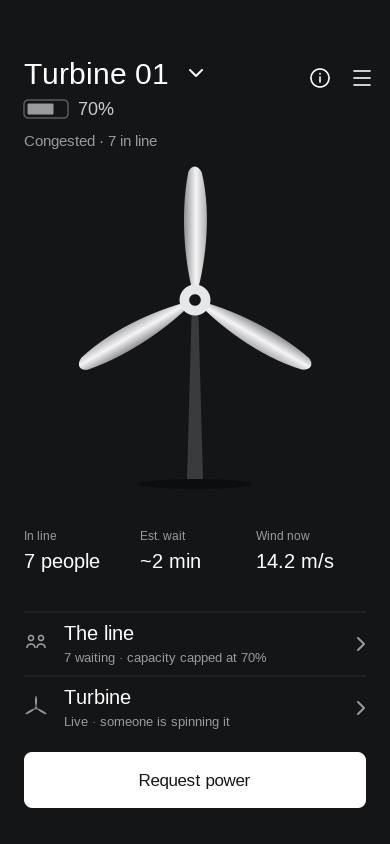
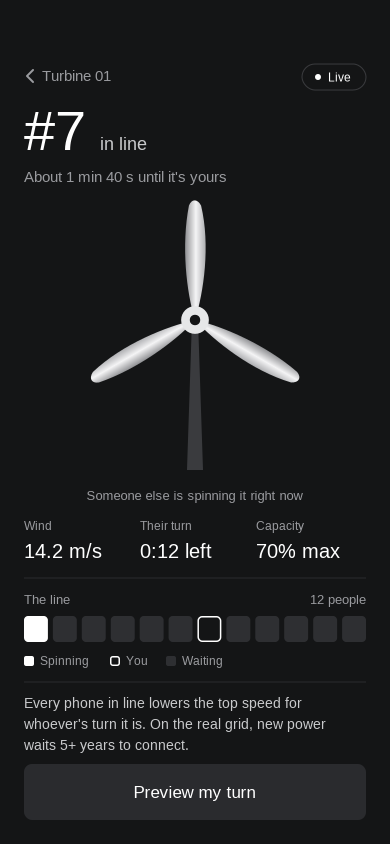
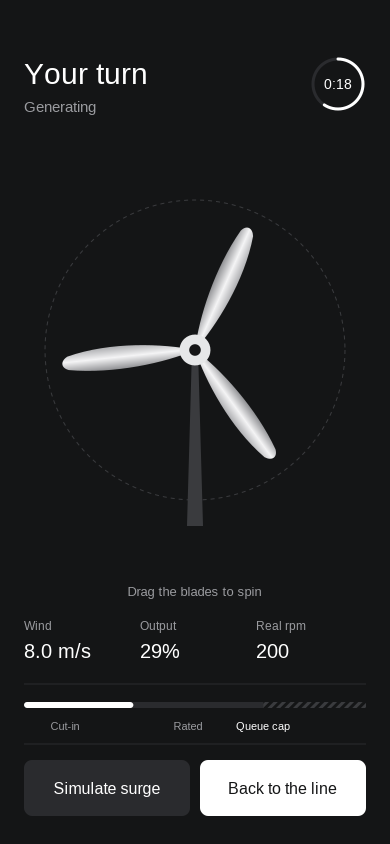
Here a single fan is shared by everyone in the room. You join the line from your phone and wait, and when your turn finally comes you can spin it as fast as you want, which feels good for exactly as long as nobody behind you asks for it. Then it's your call whether to keep it or hand it over.
The piece lives in that moment, where pleasure turns into power, and power turns into a decision about who else gets any.
Roelof Louw's Soul City (Pyramid of Oranges) (1967), where visitors are invited to take an orange from a pyramid of about 5,800, so every person who takes one changes what's left for everyone else.
Angela Bulloch's West Ham, Sculpture for Football Songs (1998), where Belisha beacons, the lights from pedestrian crossings, are wired to a microphone and flash when the room makes noise, turning everyday infrastructure into something people set off together.
Benediktas Gylys's The Portal (2024), two circular livestream screens linking Dublin and New York, was paused days after opening because of how some people used it. A reminder that a shared connection only works as long as the people on it decide to keep it that way.
A turn is 30 seconds, 3 seconds shorter for every extra person waiting, never under 15. If you're next you can ask for it early, and the person holding it gets 15 seconds to keep it or hand it over. Whoever gets it next starts at the speed the last person left it at.
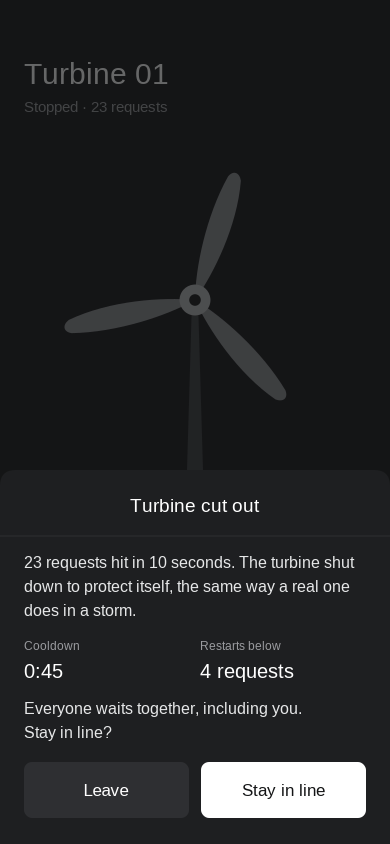
A laptop runs the line, and everything else just shows what it says: the wall, the fan and every phone in the room. The demo on this page is a copy of that logic running in your browser.
The fan is one shape everywhere. I modeled it in Maya, and the same outline is the fan you see on the wall and on your phone, so the object in the room and the one in your hand always match.
The first version was called Cut-In. Black and white, one turbine, three fixed speeds and a four digit code to join.